Autonomous Vehicle Competition
A competition-grade autonomous racing platform using ROS2, LiDAR, PID, and MPC
Project Overview
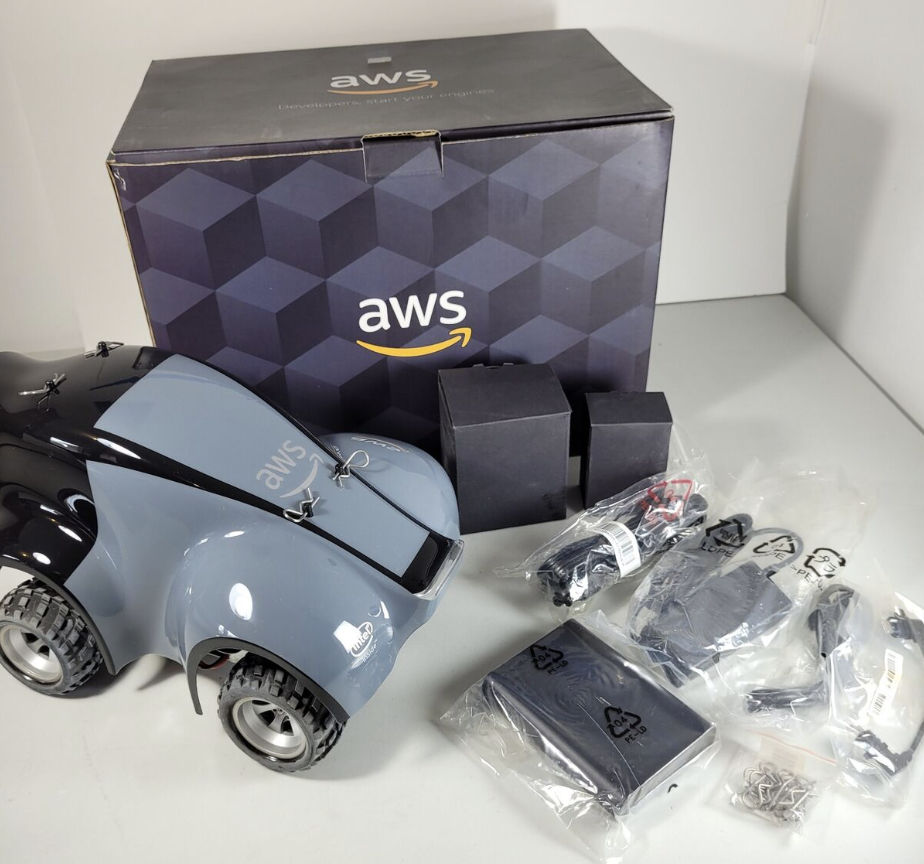
This project was developed as part of a competitive robotics challenge to build a custom AWS DeepRacer platform.
Using a Raspberry Pi, LiDAR, camera, and ROS2, the team engineered a fully autonomous system capable of navigating a closed-loop track with real-time obstacle avoidance, robust localization, and adaptive path planning.
Our team focused on building a reliable and fast robot for the indoor track competition, prioritizing robust control, accurate localization, and real-time responsiveness.
Development
We develop the robot’s localization and control stack, including:
- Engineering a LiDAR-based Extended Kalman Filter (EKF) fused with optic flow from the Pi Camera to estimate velocity and heading without relying on an IMU.
- Implementing PID and Model Predictive Control (MPC) strategies for high-speed maneuvering and trajectory stabilization.
- Designing the A* path planning algorithm for route selection, integrating real-time obstacle detection and avoidance.
- Achieved 100% lap completion with minimal deviation and smooth turns on a tight indoor track.
Hardware Integration
Building the autonomous DeepRacer platform required seamless coordination between various hardware components. The integration process included:
- Raspberry Pi served as the central processing unit, running ROS2 nodes for perception, planning, and control.
- 2D LiDAR was mounted on the chassis to provide distance measurements for localization and obstacle detection. Data was published to ROS topics and fused using an EKF node.
- A Pi Camera was positioned forward-facing, used for optic flow estimation and basic visual localization.
- A custom 3D-printed sensor mount was designed to align all sensors for minimal distortion and secure operation on the track.
- Motor controller and wheel encoders were configured to receive motion commands via ROS2
cmd_veltopics, enabling velocity and turn rate execution.
This modular hardware setup enabled us to test and tune components individually, then synchronize them for full autonomy in real-time racing conditions.
Key Features
- LiDAR-driven EKF localization, improved by 80% using optic flow for poor-man’s IMU estimation.
- Dual-controller design using PID and MPC for comparison, improving trajectory stability by 60%.
- Real-time path planning using A* on a pre-mapped environment with dynamic obstacle avoidance.
- Modular ROS2-based architecture, supporting flexible debugging and visualization tools.
- Completed full laps with 100% reliability in a constrained indoor environment.
Technical Stack
- Hardware: Raspberry Pi, 2D LiDAR, Pi Camera, custom sensor mount
- Software: ROS2 (Foxy), Python, OpenCV, NumPy, FFmpeg, Linux
- Control Systems: EKF, PID, MPC
- Planning: A*, real-time obstacle detection and avoidance
- Tools: RViz, ROS2 Nodes, Custom Visualizers, Git
Visuals

Competition Context
This work was completed for CSCI 5302: Advanced Robotics at CU Boulder.
The robot was evaluated based on performance in the indoor track competition, with objectives including fast lap time, successful obstacle avoidance, and stable localization without GPS or traditional IMUs.
Our solution focused on minimal sensor use, prioritizing algorithmic efficiency, redundancy, and reliability.